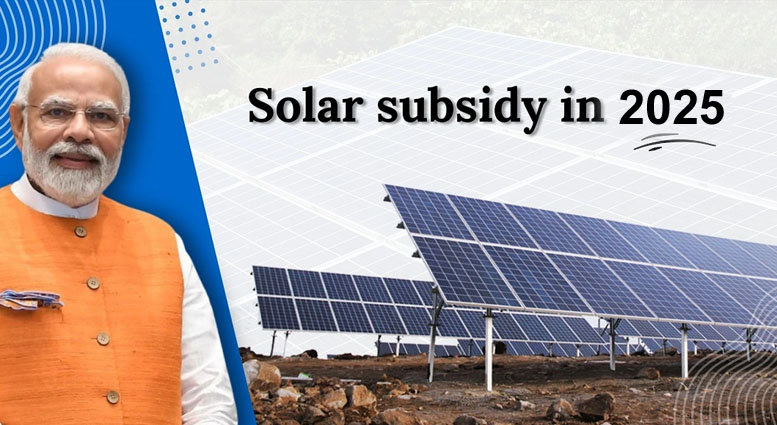
India is rapidly moving toward clean and renewable energy, and rooftop solar has become one of the top choices for homes and small businesses. To encourage more people to switch to solar, the Government of India offers subsidies, easy loans, and special schemes.
In this blog, we cover a complete guide to government schemes and solar subsidies, including:
- PM Surya Ghar Muft Bijli Yojana
- State-wise Solar Subsidy List
- How to Apply for Solar Subsidy Online (Step-by-Step)
- Net-Metering Rules in India (2025 Updated)
1. PM Surya Ghar Muft Bijli Yojana – Complete Guide
PM Surya Ghar Muft Bijli Yojana is a flagship scheme launched to promote rooftop solar adoption. Under this scheme, households can get up to ₹78,000 subsidy and 300 units of free electricity every month.
Key Benefits
- Free 300 units electricity/month after installing rooftop solar
- Up to ₹78,000 subsidy for residential consumers
- Lower electricity bills for the next 25 years
- Energy independence for households
- Easy online application through the National Portal
Eligibility
- Must be an Indian resident
- Must own the house or rooftop
- Electricity connection must be domestic (LT category)
- System must be from an approved vendor
Subsidy Structure (Approx.)
| Solar Capacity | Government Subsidy |
|---|---|
| 1 kW | ₹30,000 |
| 2 kW | ₹60,000 |
| 3 kW & above | ₹78,000 (Maximum) |
2. State-wise Solar Subsidy List in India (2025 Updated)
Along with the Central Government subsidy, many states offer additional subsidy benefits. Here is a simplified state-wise list:
States Offering Additional Subsidy
- Delhi – Up to 10–20% additional subsidy
- Maharashtra – Incentives through MEDA for group housing
- Gujarat – High subsidy for residential, up to ₹10,000 extra
- Haryana – Additional ₹10,000 per kW (up to limit)
- Uttar Pradesh – Net metering enabled but no separate subsidy
- Rajasthan – Minimal state subsidy, but central subsidy applicable
- Punjab – Attractive residential subsidy schemes
- Karnataka & Tamil Nadu – Central subsidy + state energy programs
(Note: State policies are updated frequently; always check the DISCOM/State Nodal Agency website.)
3. How to Apply for Solar Subsidy Online – Step-by-Step Guide
The government has made the subsidy process completely online through the National Solar Rooftop Portal.
Follow these simple steps:
Step 1: Visit the National Solar Rooftop Portal
Search for National Portal for Rooftop Solar.
Step 2: Register Your Account
- Select your state
- Enter your electricity consumer number
- Fill in your mobile number & email
- Verify with OTP
Step 3: Submit the Rooftop Solar Application
- Choose an approved vendor
- Select system capacity (1kW–10kW or more)
- Upload required documents
Step 4: Technical Feasibility Approval (TFR)
Your DISCOM will review and approve the feasibility.
Step 5: System Installation
After approval, your vendor installs the solar system.
Step 6: Net Meter Installation
DISCOM installs the net meter at your home.
Step 7: Inspection & Commissioning
DISCOM inspects the system and approves it online.
Step 8: Receive Subsidy in Your Bank Account
After commissioning, the subsidy amount is sent directly to your bank account under the Direct Benefit Transfer (DBT) process.
4. Net-Metering Rules in India (2025 Updated)
Net metering allows you to sell extra solar electricity to the grid. You get credits on your electricity bill for every unit exported.
How Net Metering Works
- When solar generates more power than you consume → Excess goes to grid
- When solar generation is low → You use grid electricity
- Your bill shows net units = (Consumed – Exported)
- If exports are more, the remaining credit is carried forward
2025 Updated Rules
- Net metering allowed for systems up to 500 kW (varies by state)
- DISCOM must install net meter within 15–30 days of request
- Settlement cycle is monthly (in most states)
- Banking allowed in many states except a few
- Mandatory for obtaining subsidy under the national portal
States with Friendly Net-Metering Policies
- Delhi
- Gujarat
- Uttar Pradesh
- Rajasthan
- Punjab
- Karnataka
- Maharashtra
- Haryana
